
Why should you be interested in Flutter app development? The days of waiting in never-ending lines to see your doctor are nearing their end, thanks to the growing number of healthcare mobile applications. Smartphones are ubiquitous, nearly everybody has one these days, and it opens much-needed possibilities for the further development of mobile healthcare. Accessibility to healthcare makes considerable changes to the quality of life for millions of patients, and thus it is essential to deliver quality healthcare services through different media.
According to market research reports from GlobeNewswire, the global mobile health market is expected to grow from $83 billion in 2022 to well over $250 billion in 2026 at a compound annual growth rate of 31.53%. But how do you capitalize on modern healthcare trends and develop healthcare mobile applications that help save lives and make some bang for your buck?
You need to build your application fast, make it stable, troubleshoot immediately, and make the whole process cost-efficient. That is where Flutter app development comes into play. Flutter is an open-source UI software development kit created and supported by Google, engineered specifically to build apps across multiple platforms from a single codebase.
Let’s see why Flutter app development in healthcare is faster, simpler, and more cost-efficient for modern medical practices, startups, and hospital networks worldwide.
Are you ready to build a high-performance healthcare app with Flutter? Contact SPsoft to consult with our specialized Flutter engineering team and launch a secure, HIPAA-compliant cross-platform medical app that delivers native-like speed and flawless UI consistency!
Table of Contents
How Does Flutter App Development Help in Healthcare?
One of the most common problems in mobile app development for healthcare is that it takes a massive amount of time to create the same application for different operating systems. Let’s say you need to build a Flutter app that runs seamlessly on iOS and Android, web browsers, and desktop operating systems. Traditionally, you would need to hire separate engineering teams: Swift and Objective-C experts for Apple devices, and Java or Kotlin specialists for Android apps.
You would spend double the time coding business logic and even more time tweaking the responsive layout so it fits different tablet and phone screen sizes. That requires a considerable amount of time, management overhead, and capital investment.
Flutter app development solves this problem permanently. Flutter is a cross-platform development framework and SDK that allows a developer to launch applications across Android and iOS, web, and desktop using the Dart programming language. While other cross-platform options like React Native exist on the market, the Flutter framework possesses architectural features that distinguish it from the competition. This allows teams to achieve exceptionally fast development and cost-efficiency.
Same Business Logic and UI on All Platforms
Most cross-platform development kits have in common that you can share business logic between different platforms. So, if you have dealt with mobile development in healthcare, you could use a shared layer with slight native adjustments to port your application to another platform. But only Flutter development lets you share both the underlying UI code and the rendering engine itself.
How Traditional Frameworks Handle UI Rendering
To understand why engineering teams choose Flutter, let’s look at how most cross-platform frameworks handle screen rendering. Many frameworks use a JavaScript bridge to talk to native components. While this rendering process has its perks and applications look native, relying heavily on platform-specific components creates a property mapping layer for each platform widget. This also requires constant data synchronization with framework widgets.
Here is how most cross-platform frameworks deal with UI rendering:

So, developers must map animations into platform-specific widgets, spending valuable hours on platform-framework synchronization and debugging compatibility issues when an OS updates.
How the Flutter Engine Renders UI
Flutter renders widgets entirely on its own using its built-in, high-performance graphics engine (Impeller/Skia). All the Flutter framework needs is a canvas to draw on:
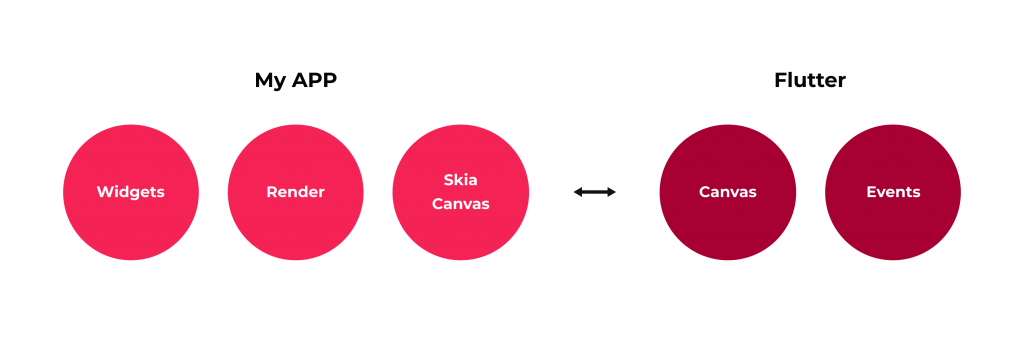
Flutter apps are written in the modern Dart language, where everything on the screen is a widget. The engine compiles code natively to machine instructions without bridging layers. The framework includes a comprehensive UI toolkit providing pre-built Flutter widgets that follow both Google’s material design guidelines (Material Design) and Apple’s Cupertino styling.
Whether rendering stateless presentation layers or complex stateful widgets tracking streaming vitals, Flutter widgets guarantee visual pixel-perfection across all devices. The simplicity of rendering offered by Flutter’s architecture ensures total UI consistency across operating systems. Sharing business logic and interface design becomes seamless. This helps you cut the timeline and cost of development while making it easier for healthcare practitioners to interact with the Flutter medical app across diverse devices.
Reduced Time-to-Market and Hot Reload
Flutter app development accelerates the delivery lifecycle compared to traditional native stacks. You can expect to build and launch the app up to two times faster than developing two separate applications for Android and iOS. The reason is simple: you write your business rules and interface once using a single codebase.
One of the standout features beloved by the global Flutter community is Stateful Hot Reload. When developers make code changes in their Flutter code, the framework injects the updated source code files directly into the running Dart Virtual Machine (VM) without losing state.
| Developer Modifies Dart Code ➡️ | Hot Reload Triggers ➡️ | App Updates Instantly (<1 sec) ➡️ | User State Preserved |
In a healthcare context, this means an engineer can adjust a complex medical triage form, refine real-time vital sign charts, or tweak e-prescribing validation logic and see the result instantly on a connected device without restarting the application or losing inputted test data. This sub-second feedback loop streamlines the app development process. It allows startups and hospital networks to iterate on features, troubleshoot bugs immediately, and deploy apps quickly to both the Apple App Store and Google Play.
Native-like App Performance and Dart Language Benefits
The performance of your mobile application is vital for a quality user experience. It is critical for healthcare mobile apps, where lag or visual stutter hinder a clinician’s ability to review urgent medical charts or track real-time telemetry during an emergency. The performance achieved through Flutter development is virtually indistinguishable from native Swift or Java builds.
Because Flutter apps are written in Dart, the code is Ahead-Of-Time (AOT) compiled into native 64-bit ARM machine code for both iOS and Android. This eliminates the performance overhead, garbage collection pauses, and serialization bottlenecks associated with JavaScript bridges.
| FLUTTER VS. TRADITIONAL NATIVE | ||
| Feature | Native (Swift & Java/Kotlin) | Flutter (Dart Single Codebase) |
| Codebases Managed | Two separate codebases | One unified codebase |
| UI Consistency | Requires manual visual alignment | 100% identical pixel-perfect UI |
| Development Speed | Slower (parallel engineering teams) | Up to 50% faster time-to-market |
| Hot Reload Support | Limited / Slow rebuilds | Sub-second Stateful Hot Reload |
| Multi-Platform Expansion | Mobile only (re-write for Web) | Mobile, Web, and Desktop ready |
| Compilation Method | Native machine code | Direct AOT native machine code |
| Null Safety Protections | Platform-dependent | Sound compile-time null safety |
Furthermore, the Dart programming language includes built-in sound null safety. In healthcare software, runtime crashes due to null-pointer exceptions can corrupt patient charts or interrupt emergency teleconsultations. Dart’s sound null safety guarantees that variable errors are caught at compile-time rather than during runtime in the hands of a doctor, ensuring unmatched system stability and data integrity.
Simple Operating System Logic Implementation
Apart from standard UI rendering, healthcare applications rely heavily on advanced operating system-level hardware integrations:
- Bluetooth Low Energy (BLE) connectivity for medical biosensors
- GPS coordinates for emergency geolocation routing, biometric authentication (FaceID/Fingerprint)
- Encrypted local key storage
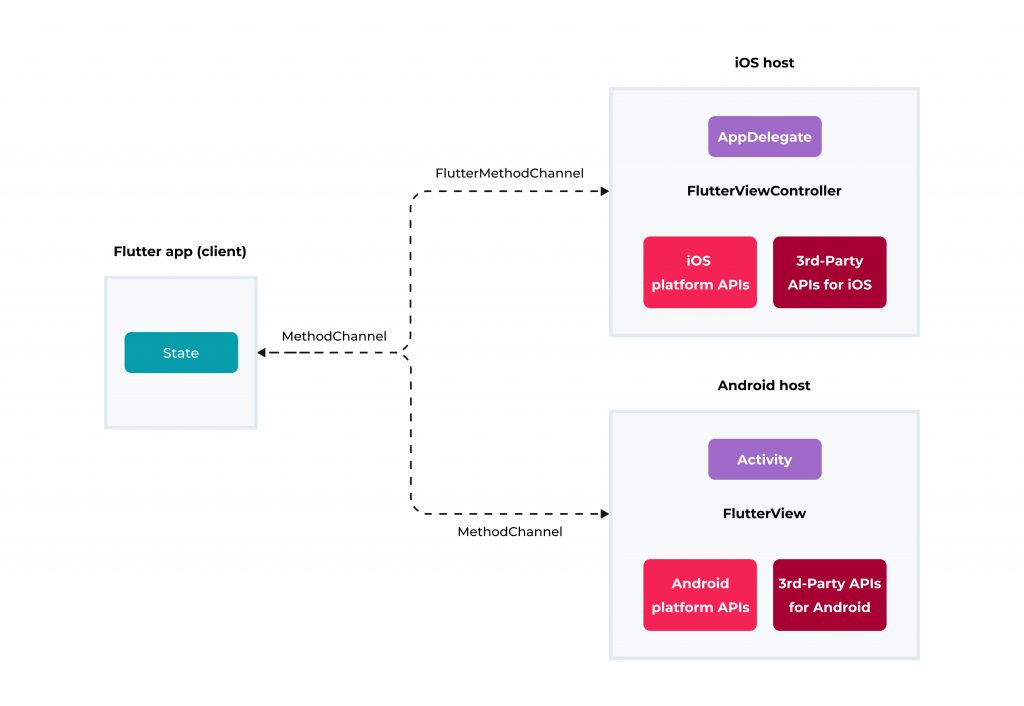
With Flutter 3 and modern architecture, these features are readily accessible via an extensive ecosystem of production-grade plugins maintained by the Flutter team and community. When a project requires unique or proprietary hospital hardware integration, engineers can establish custom communication using Platform Channels.
Platform Channels allow the Dart layer to send messages to native host code (Swift on iOS, Kotlin/Java on Android) and receive responses seamlessly. This allows developers to integrate specialized medical devices, such as ultrasound probes, digital stethoscopes, and encrypted smartcard readers, into a unified Flutter interface without sacrificing performance.
Multi-Platform Reach: Beyond Mobile to Web and Desktop
With the release of Flutter 3, the toolkit evolved into a true multi-platform framework. Developers can use Flutter to build responsive web applications and desktop applications (Windows, macOS, Linux) directly from the exact same repository used for mobile.
| Unified Flutter Dart Codebase ➡️ | ➡️ iOS (iPhone / iPad) ➡️ Android (Smartphones / Tablets) ➡️ Web (Clinician Portals / Dashboards) ➡️ Windows (Hospital Workstation Software) ➡️ macOS / Linux (Clinical Lab Workstations) |
For healthcare organizations, this multi-platform capability offers immense strategic advantages:
- Web Applications. Clinical administrative portals, patient intake forms, and telemedicine dashboards can run directly in standard web browsers without rewriting frontend logic in React or Angular.
- Desktop Workstations. Hospital nurses and administrative staff can run the software natively on Windows or macOS hospital PCs, ensuring seamless data synchronization with mobile apps used by rounding physicians.
- Embedded Medical Devices. Flutter’s lightweight engine can be embedded directly into custom touchscreen hospital equipment, providing a modern, touch-responsive interface for operating room monitors and bedside telemetry hubs.
Flutter is a game-changer that eliminates the friction of maintaining fragmented development teams across mobile, web, and desktop environments.
5 Major Healthcare Mobile App Trends and Flutter’s Impact
With the expansion of connected health and remote care models, digital transformation is redefining medical care delivery. Here are the five major trends shaping the healthcare sector and examine how cross-platform app development with Flutter accelerates their implementation.
1. Universal Access to Quality Care for Remote Patients
In this digital age, high-speed internet connections and smartphones are far more ubiquitous than physical medical clinics. This connectivity allows residents of rural or underserved regions to schedule video calls with specialists, engage in secure text chats, and receive digital prescriptions based on their conditions.
How Flutter Empowers: Developing real-time telemedicine platforms requires responsive video calling layouts and instant chat feeds. Using Flutter’s pre-built widgets, developers can build intuitive video consultation interfaces that adapt across budget Android smartphones and high-end iPads alike. This ensures low-latency communication and reliable access to care.
2. AI-Driven Diagnostics and Decision Support
Modern clinical workflows leverage artificial intelligence and machine learning to analyze patient health data. While complete automation remains under human clinical oversight, AI algorithms can evaluate symptom inputs, flag subtle patterns in vital signs, and provide diagnostic decision support to attending physicians.
How Flutter Empowers: A Flutter app that generates diagnostic summaries can ingest real-time symptom questionnaires and display structured risk scores instantly. Dart easily interfaces with cloud-based machine learning APIs and edge-based TensorFlow Lite models, enabling on-device inference for instant triage recommendations.
3. Continuous Wearable Monitoring and IoT Health Trackers
Patients are taking an active role in personal wellness by using fitness trackers, smartwatches, and clinical IoT devices. These wearables monitor heart rates, blood oxygen levels, ECG rhythms, and glucose spikes in real time.
How Flutter Empowers: Flutter’s platform channels enable direct communication with Bluetooth Low Energy (BLE) medical sensors. If a patient’s vital signs reach dangerous thresholds, the Flutter application immediately parses the incoming data packet and triggers local emergency alerts and background notifications to the care team.
4. Seamless Electronic Health Record (EHR) Integration
Electronic Health Records (EHR) are the operational core of modern hospitals, containing longitudinal patient histories, lab results, and medication regimens. Clinicians rely heavily on mobile EHR portals during hospital rounds to review charts and log updates.
How Flutter Empowers: Building mobile EHR portals with Flutter allows organizations to implement HL7 FHIR REST APIs within a single codebase. Doctors enjoy a responsive, standardized interface on mobile and tablet devices, eliminating manual data entry duplication and reducing documentation burnout.
5. Affordable Virtual Clinics and Practice Expansion
Hospital visits can place significant financial strain on patients due to administrative overhead. Virtual clinics powered by mobile apps offer cost-effective consultations, expanding access for patients while allowing physicians to manage hybrid schedules efficiently.
How Flutter Empowers: By cutting development timelines and maintenance costs in half through a single codebase, healthcare startups and private practices can launch virtual care platforms without massive capital expenditures, passing operational savings directly to patients.
Crucial Considerations for Healthcare Flutter Development
While Flutter provides unmatched cross-platform efficiency, engineering healthcare applications requires strict adherence to regulatory and architectural standards.
Regulatory Compliance and HIPAA Safeguards
Any medical software handling electronic Protected Health Information (ePHI) in the United States must comply with HIPAA regulations (and GDPR in Europe). Developers must ensure:
- End-to-End Data Encryption. Enforce AES-256 bit encryption for local storage (using secure storage plugins backed by iOS Keychain and Android KeyStore) and TLS 1.3 for all network data in transit.
- Biometric Authentication. Implement multi-factor authentication and biometric logins with automated session timeouts.
- Audit Trail Logging. Maintain unalterable, encrypted access logs to record every instance a user views, edits, or exports patient records.
State Management Best Practices
Healthcare applications process complex, streaming datasets, from continuous ECG lines to multi-tier appointment schedules. Utilizing mature state management patterns, such as BLoC (Business Logic Component) or Riverpod, separates UI presentation from underlying clinical business logic, ensuring testability, maintainability, and predictable app performance.
Final Thoughts
The healthcare industry is experiencing rapid digital modernization. As patient demand for accessible remote care, IoT monitoring, and virtual clinics continues to surge, organizations must deploy cross-platform applications quickly, reliably, and securely.
Flutter is supported by global engineering leaders and provides the ideal development framework to create cross-platform apps that combine native performance with rapid development speed. By writing code once in Dart and deploying across iOS, Android, web, and desktop, healthcare providers reduce time-to-market and deliver exceptional patient experiences. SPsoft is the technology partner that can help you architect, build, and scale your healthcare Flutter application from initial concept to commercial success.
Are you considering future-proofing your healthcare software architecture? Message SPsoft’s team to receive a comprehensive technical consultation and discover how our Flutter engineering services can turn your clinical vision into an exceptional, scalable cross-platform application!
FAQ
What is Flutter and why is it beneficial for healthcare app development?
Flutter is an open-source UI software development kit created by Google that allows devs to build high-performance applications for iOS, Android, web, and desktop from a single codebase. In healthcare, Flutter is beneficial because it cuts development time and costs by up to 50%, eliminates UI inconsistencies between platforms, and provides native-like 60fps performance.
Can a Flutter application be made fully HIPAA compliant?
Yes, a Flutter app can achieve full HIPAA compliance. Compliance depends on system architecture and data security implementations rather than the UI framework itself. By using Flutter plugins that interface with secure hardware-level storage, enforcing encryption for data at rest and for data in transit, integrating multi-factor authentication, and maintaining immutable audit logs, Flutter applications safely protect electronic PHI.
How does Flutter compare to React Native for medical mobile apps?
While both frameworks support cross-platform development from a single codebase, Flutter renders UI directly via its own graphics engine (Impeller/Skia). Meanwhile, React Native relies on a JavaScript bridge to communicate with native platform widgets. Flutter’s direct compilation to native ARM machine code provides superior rendering performance, predictable 60fps animations, and eliminates bridging lag.
How does Flutter handle real-time data from wearable medical devices?
Flutter handles real-time medical IoT data using Platform Channels and event streams that connect Dart code directly with native Bluetooth Low Energy (BLE) APIs on iOS and Android. This allows the application to continuously ingest streaming telemetry packets from wearable biosensors, such as continuous glucose monitors or pulse oximeters, and update reactive UI widgets instantly without causing frame drops or battery drain.
Is Flutter suitable for complex electronic health record (EHR) systems?
Yes, Flutter is well-suited for building complex EHR and clinician portals. With support for responsive layouts, web, and desktop platforms, a single Flutter codebase can power mobile rounding apps for doctors and desktop workstation software for hospital administrators. Flutter easily integrates with modern healthcare data standards like HL7 FHIR using standard RESTful APIs and WebSockets.
What is Stateful Hot Reload and how does it accelerate medical software development?
Stateful Hot Reload is a core Flutter feature that allows developers to inject source code updates directly into a running app in less than a second without losing the current application state. This means developers can modify complex clinical forms, adjust UI styling, or fix algorithmic validation logic without restarting the app or re-entering multi-step patient test data.
Can a single Flutter codebase support mobile, web, and desktop hospital software?
Yes, Flutter 3 natively supports multi-platform compilation across iOS, Android, web browsers (Chrome, Safari, Edge), and desktop operating systems (Windows, macOS, Linux). This unified multi-platform capability allows healthcare networks to develop patient mobile apps, physician web dashboards, and hospital administrative desktop software from a unified repository.