Digital transformation of the healthcare sector brings forward automation in healthcare across clinical and operational fields. As a result, it makes healthcare service provision more efficient and highly simplified. In the end, when done correctly, all parties benefit from this. Yet, one of the challenging things is to choose the right instrument of digitization among the many options.
One of the most promising tools in such a case is Robotic Process Automation (RPA). RPA in healthcare can be an absolute game-changer if placed in the right technical hands, especially as healthcare operations can improve efficiency through targeted software deployment.

The global RPA market is booming and is projected to reach $24 billion by 2030, reflecting rapid RPA market trends and adoption patterns. Forbes also indicates more than 50% of healthcare providers in the US will invest heavily in robotic process automation in the next three years. Finally, many practitioners, precisely 92% of respondents in Deloitte’s research, anticipate digital transformation, and healthcare RPA in particular, to provide a vastly superior patient experience. These statistics presume the importance of robotic process automation in healthcare models.
At this point, let us explore the RPA technology in greater detail and analyze five critical use cases in healthcare settings to assess the power of the phenomenon.
Are you ready to eliminate repetitive administrative overhead? Contact SPsoft to consult with our automation engineers and deploy resilient RPA solutions that modernize your healthcare workflows!
Table of Contents
What Is RPA?
Robotic process automation is a distinct software technology that allows companies to build and deploy software-based robots quickly. These RPA robots emulate human behaviors and routine actions while interacting with software and other digital legacy systems. For example, software robots built in the scope of an enterprise RPA implementation can see and comprehend what is displayed on a smartphone or desktop screen.
Besides, they can complete different keyboard keystrokes, extract data, and navigate digital networks faster and more efficiently than human operators. With specialized healthcare cloud software, an automated RPA solution gains massive traction in clinical data management. You need no on-premise systems, which means fewer maintenance expenses and lower downtime. Thus, software robots can process healthcare data through the cloud and grant practitioners insights that improve patient care.
RPA can automate repetitive tasks, taking a great deal of mundane data compilation off the hands of the clinician. The RPA in healthcare involves executing critical healthcare tasks like:
- Logging into internal systems and core applications
- Moving legacy files around separate departments
- Completing automated financial analysis
- Creating compliance-ready reports
- Engaging in complex cognitive processing
- Running interactive customer chats
- Interpreting text and scanning document templates
- Collecting and compiling unstructured patient data
- Applying learning techniques to present complex insights
Software robots’ possibilities range from low-value mundane tasks to complex analyzing and processing. Therefore, automation solutions bring immense freedom to human teams. When the healthcare automation process is designed and executed correctly, this advanced tech has a lot to give to the entire healthcare industry.
What Does Healthcare RPA Development Bring to the Table?
Healthcare development automation is something RPA software is highly proficient in. With the RPA in the healthcare market booming, companies and healthcare institutions continuously find new ways to implement the technology and improve patient experiences.

It is crucial to understand that the healthcare industry is full of robust and strict standards, rules, and principles that put forward hundreds of complex requirements. It is a mandatory baseline for quality healthcare provision. Besides, these are needed to ensure patient safety and data protection if speaking on digital transformation. That poses a significant challenge for healthcare providers trying to balance providing care and earning profits.
With all the regulations and compliance-related matters in mind, healthcare professionals constantly engage in a myriad of administrative tasks. Often, it means working with tedious data entry workflows or shuffling a medical record across separate healthcare systems like Electronic Health Records (EHRs). This manual burden takes a heavy toll on healthcare staff who could have used that valuable time for clinical interactions.
This is the exact moment when robotic process automation in healthcare comes to the center stage. Implementing RPA helps healthcare organizations achieve data automation. That saves valuable hours, allowing healthcare professionals to focus on personalized care while reducing the baseline cost of the process. Furthermore, deploying an automated RPA solution is excellent for compliance. Software robots ensure almost no mistakes and errors in critical healthcare tasks when an organization tries to meet strict regulatory criteria.
The Scope of Healthcare RPA Development
To maximize operational throughput, healthcare organizations need to combine RPA with Artificial Intelligence (AI), Machine Learning (ML), and Intelligent Automation (IA). Integrating RPA with cognitive tools grants an unprecedented ability to manage interactions and tasks between healthcare software points cleanly. This cross-pollination of tools expands the scope of healthcare automation across four primary areas.
Patient Experience
For decades, interactions between healthcare providers and patients relied heavily on manual data capture during check-ins. However, with the use of RPA and AI, the system has completely revolutionized. It makes the traditional generalized approach toward scheduling obsolete and enables healthcare institutions to adopt a personalized touch to their healthcare service delivery.
Looking closely at COVID-19 vaccination efforts, automation and RPA helped organize complex vaccination schedules while automatically sending patients targeted reminders and notifications.
Clinical Decision-Making and Support
To understand the full value of RPA for healthcare, it is crucial to look at how information flows across healthcare workflows. When diagnosing, a practitioner must evaluate various PHIs, historical lab reports, and other distinct variables. Reviewing this data manually for dozens of active patients creates severe clinical inefficiency.
Advanced AI applications can aid with that, allowing healthcare staff to use insights developed by software bots. In short, with RPA and AI, clinical decision support becomes automated, eliminating human errors and allowing clinics to rapidly devise personalized treatment plans.
Medical Transcription
Clinical documentation is still heavily rooted in the manual work of filling out forms, notes, and records. This manual burden increases the chance of data omission. Yet, an RPA bot equipped with natural language processing (NLP) can effectively transcribe and edit dictations directed to other medical professionals. Also, when incorporating RPA with deep learning, a machine can handle the documentation process autonomously, letting clinicians stay engaged with patients.
Staff Utilization Optimization
This part of the RPA technology scope emphasizes dealing with the grueling staff shortage issue that threatens global healthcare. Reports indicate that by 2025, the industry will experience a shortage of hundreds of thousands of medical professionals. This issue can be minimized with RPA in healthcare. Organizations can deploy automation solutions that use predictive analytics to anticipate how the workforce will shift. Such an approach will help healthcare facilities achieve correct staff utilization and avoid operational burnout.
RPA in Healthcare Development Benefits
According to recent technology studies, a significant portion of all patient interactions will soon involve some degree of AI and robotics. This shows that healthcare leaders recognize that healthcare processes automation is the future. Beyond simple utility, adopting RPA delivers distinct and tangible benefits of RPA in healthcare.
Tailored-to-User-Needs Experience
From the scope above, it becomes clear user experience plays a vital role in healthcare provision. Any industry relying on services can envision this factor as critical. Better user experience means a lower user turnover rate and more profits. The formula is simple. With all the myriad factors involved, offering a great user experience in healthcare is challenging.
However, an RPA bot helps healthcare professionals provide a personalized user experience. Software robots can complete various administrative tasks in a fraction of the time compared to humans. What took 10 minutes can be done in 10 seconds. Also, with predictive analytics on board, RPA helps analyze patient needs and anticipate what a user will look for in the nearest future. As a result, healthcare providers can satisfy patients who will return to get more services.
Better Appointment Turnout
Appointment scheduling can be a major headache for an existing healthcare facility. Essentially, a dedicated employee must manage all the scheduling and ensure various visits do not overlap. Naturally, it comes with human errors and patients getting the wrong scheduling. Thus, RPA can automate patient scheduling and take away the need to allocate human resources to do tasks.
With available data storage options and effective cloud data management, there is no need for on-premise systems that hold patient data and slow down the scheduling process. So, with RPA in healthcare, a patient gets a seamless scheduling experience while hospitals reduce the costs.
No Human Errors
While there was mention of human error elimination before, the notion needs a closer look because of its importance. Unfortunately, medical errors resulting from human errors lead to about 161,000 deaths annually.

Therefore, RPA in healthcare can save lives. Coupled with Big Data capabilities, it grants practitioners error-free insights, significantly reducing prescription errors and misdiagnoses.
Enhanced Data Protection
With digital transformation being a prerogative for healthcare providers, data protection is among the critical aspects everyone tries to solve. Thus, ensuring patient data is secured against a breach is one common challenge.
Most data breaches occur because humans mishandle patient data. People do not follow the rules and can leave sensitive information open for unauthorized access. Yes, this can be both intentional and unintentional. However, the result will be the same – patient data will be lost. To address that, you need to eliminate the human factor. Software robots can handle all the data, generate reports, and conduct analysis. Thus, the machines ensure the adoption of proper data security measures and safeguard protected health information (PHI) from unauthorized access.
Top-of-the-Line Security
While AI in healthcare is perfect for data analysis, RPA is excellent for security. But why is it so crucial? HIPAA reports a 30% increase in data breaches within the healthcare sector due to security-related weaknesses across healthcare providers.

How can RPA in healthcare help? Again, the technology takes all data handling into its “hands.” It ensures all the inputs are done according to HIPAA regulations, and all the reports follow the highest compliance standards. Also, RPA comes with firewalls and protective measures, which make it virtually impossible to hack them and use them as the access door into the system.
Top 5 RPA Applications in Healthcare
The following use cases of RPA illustrate the most promising opportunities to transform healthcare operations and deliver highly efficient healthcare models.
1. Effective Appointment Scheduling Procedures
Appointment scheduling is something that should be stressed again and again. Making appointments online is one of the most well-recognized trends.

The healthcare industry comes right after the travel industry, with 52% of patients and staff using online appointment scheduling regularly. Also, according to Verified Market Research, the global appointment scheduling software market is expected to reach $588 million by 2027, a great increase from its current value of $223 million. Considering the evidence, this is the realm healthcare professionals seek to improve.
While appointment scheduling went online, processing these bookings is still a manual task. Now, think about tens or even hundreds of doctor appointments booked. Some of them will be canceled, while others might be rescheduled. Often, there is only one administrator to process the bookings. As a solution, the application of RPA in healthcare brings forward RPA bots that automatically manage all of them. They can do the following:
- Present appointment slots per patient’s needs and doctor’s availability
- Schedule an appointment once it is booked and remove the previously opened slot
- Notify the patient via email or messenger confirming the details of the appointment
This removes all the challenges of appointment scheduling and streamlines the process.
2. Top-Notch Billing Processes
Next comes billing — another major part of the healthcare automation journey. The medical billing outsourcing market is taking massive strides, with companies choosing how to handle it.
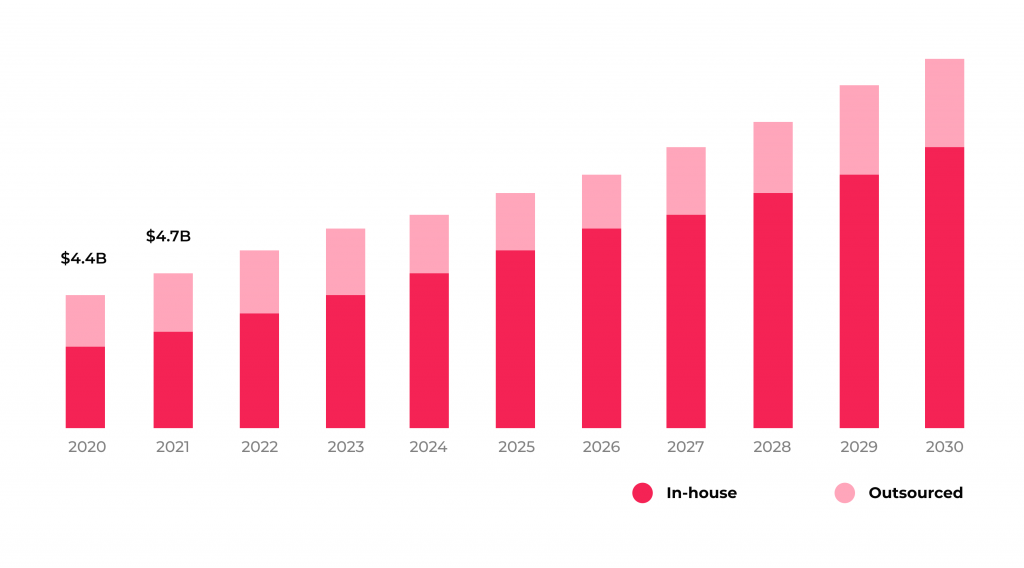
While the medical market is booming, there comes the issue of error minimization. According to GlobeNewswire, an estimated 80% of medical bills contain errors that lead to massive financial losses. In the US alone, doctors lose around $125 billion due to errors in medical billing.
Moreover, medical billing, like insurance claims and payments, includes repetitive workflows. These are time-consuming and laborious. That is precisely why medical errors occur. People who process medical billing are under immense pressure as they handle a massive workload. Luckily, RPA in healthcare comes to help. The technology ensures compliance by eliminating human factors and guarantees error-free medical billing.
An RPA bot can conduct many tasks that reduce the error rate, such as the following ones:
- An RPA-based bot can recognize and analyze all the payment details by using Optical Character Recognition (OCR).
- After recognizing the information, the bot can log it into the accounting system by inputting the data into all the relevant fields.
- Next, the system creates an invoice with all relevant fields filled. The bot registers it and then emails all the information to the patient.
- If something happens to a payment, for instance, a delay, the bot sends a customized reminder to the patient affected by the delay.
Soon, we can expect all the billing tasks to be handled by the healthcare automation process brought by RPA.
3. Clear Discharge Instructions
Most existing healthcare organizations operate via EHRs. Yet, even though the system still offers its benefits, the EHR market is stalling and will continue to stagnate in the years to come.

With this in mind, let’s see how RPA reshapes the patient discharge process. In short, a patient must follow a post-treatment plan when discharged from a hospital. Yet, often, patients forget the details of such plans and miss the procedures scheduled for later. Thus, RPA in healthcare helps patients pass the discharge process as smoothly as possible. It happens in these steps:
- The RPA bot runs the system, contacts the patient and sends all the discharge and post-treatment guidelines.
- Following the post-treatment recovery plan, an RPA bot notifies a patient with remainders and offers options to schedule and reschedule appointments if needed.
In some cases, RPA bots can notify patients daily or hourly if medication pick-ups are needed. In turn, they also notify healthcare providers of any treatment plan inconsistencies on the part of a patient. Respectively, RPA does a great job in handling the discharge process and promoting closer patient-practitioner connections.
4. Error-Free Audits
Healthcare is unimaginable without audits. Any healthcare app development needs to undergo a series of processes that verify its full compliance with the strictest standards. Again and again, it is required to protect sensitive user data. However, another side of the problem is the financial one — noncompliance is a costly endeavor.
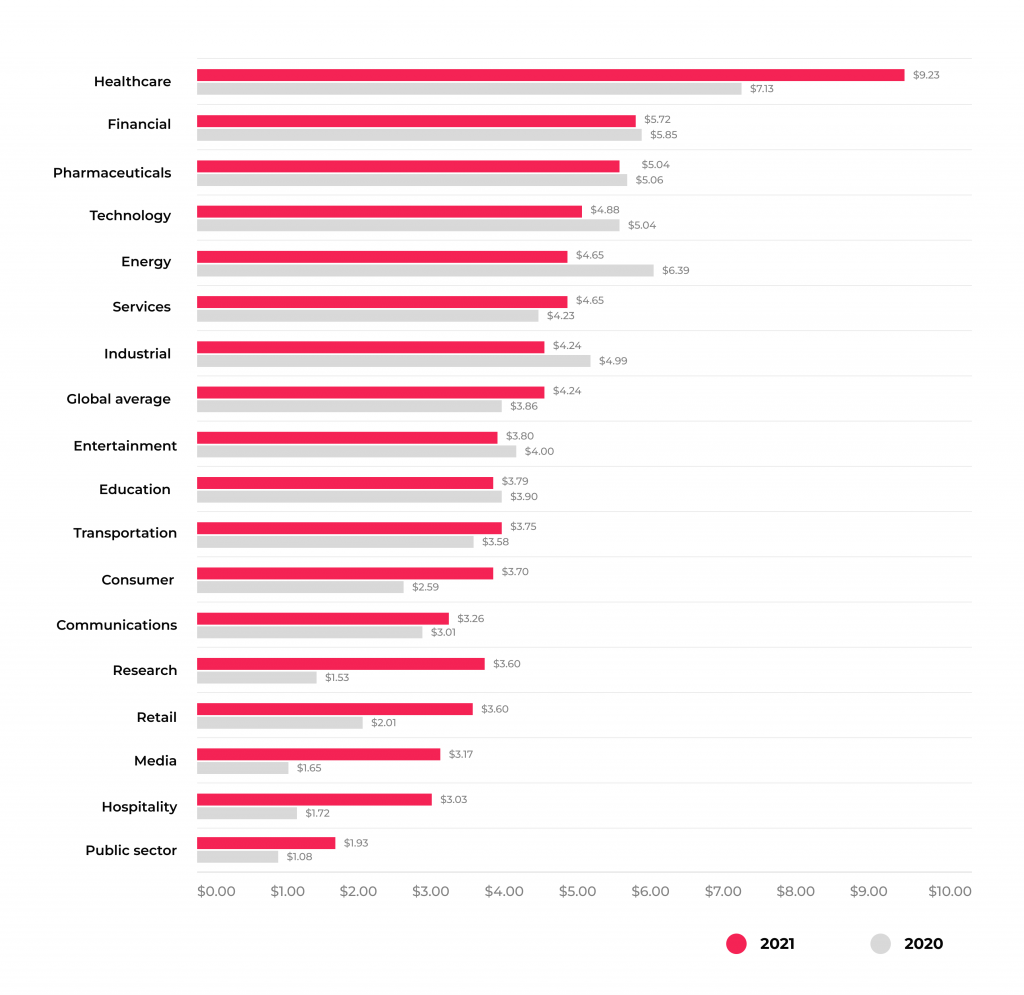
According to IBM security, data breaches happening in the healthcare industry are the costliest. On average, the incident can cost up to $4 million. In such a case, auditing is the solution to the issue. If a company or a healthcare provider passes all the audits, there is a high chance that the data breach will not happen. Audits are done periodically and can be linked to many various processes, from patient-based service efficiency to safety check processing.
However, with RPA in healthcare, auditing can become seamless. That is how it happens when the healthcare automation process is involved:
- An RPA bot records relevant audit data and starts generating the report
- Then, the machine sends out surveys which later process the results
- As the next step, an RPA bot automates all audit-related collection activities
- Later, the software integrates all the data into a single report
- The audit itself is presented in spreadsheet form
This auditing process comes with risk assessment opportunities. RPA ensures everything is documented correctly and reports are shared among respective parties. With auditing done by RPA, you can evaluate your entire system and see where potential breaches might occur. So, you take action in advance and ensure you will not lose money in data breach-related litigation.
5. Next-Level Compliance
Along with the costliest data breaches, the medical industry is among the most regulated ones.

For healthcare, internal and external compliance requirements are involved. While internal compliance is easy to handle, external compliance can pose a major challenge and catch employees off-guard. As a solution, RPA in healthcare can help automate, track, and document all the processes necessary for meeting the strictest and most robust compliance requirements.
The machine works out the process in the following manner:
- First, it eliminates the inefficiencies linked to collecting, compiling and processing data needed for compliance matters.
- Second, an RPA bot conducts a sophisticated pre-compliance check-up to identify non-compliance processes for internal audits.
- Third, the software robot creates trails you can use to extract data at any given time.
Keeping this in mind, RPA in healthcare helps handle audits and ensure your company or organization has all its processes that comply with internal and external regulations.
The Bottom Line
RPA in healthcare is an inevitable part of the industry’s digital transformation. It brings major benefits, has a distinct operational scope, and works in perfect harmony with AI and machine learning. The top 5 cases of RPA in healthcare mentioned above illustrate how software robots can revolutionize appointment scheduling, medical billing, auditing, and compliance checks.
It is the prime time for healthcare institutions to embrace this tech, ensuring that their human workforce focuses on improving patient care instead of dealing with repetitive, laborious tasks.
Are you considering modernizing your healthcare operations? Message SPsoft to receive a detailed technical consultation and discover how RPA tools can help you eliminate administrative waste!
FAQ
What is the simple definition of RPA in healthcare?
RPA in healthcare refers to the strategic deployment of specialized robotic process automation software to create, manage, and run automated bots that emulate human digital behaviors. An RPA bot can log into software systems, copy and paste data fields, move files between folders, and fill out administrative forms without human intervention. By integrating RPA into workflows, a healthcare organization can automate its most tedious, repetitive, and time-consuming tasks. This increases operational efficiency and allows your staff to focus back on direct patient care.
How does robotic process automation differ from standard health IT solutions?
Traditional healthcare software solutions require human operators to manually type data, open separate application screens, and manage workflows within the system. Conversely, robotic process automation operates on top of your existing user interface, acting as a virtual employee. An RPA bot can interact with multiple, completely disconnected applications, such as reading a lab PDF and typing the results into an electronic health record. It requires no expensive, deep database integration or changes to the underlying healthcare systems.
What are the primary benefits of RPA for a healthcare provider?
The core benefits of RPA include a great reduction in administrative operational costs, total elimination of data transcription errors, faster reimbursement cycles, and strong data protection. By utilizing an automated RPA solution, a healthcare provider can process medical billing and insurance claims with absolute speed, which prevents costly claim denials. Besides, software robots can work 24/7 without fatigue. This helps reduce healthcare professional burnout by offloading the massive administrative paperwork burden from the clinical workforce.
What are some common examples of RPA in healthcare workflows?
Practical examples of RPA in healthcare include automating patient appointment scheduling, processing medical insurance claims, executing real-time patient eligibility verifications, and managing post-discharge care tracking. Another critical healthcare RPA use case involves hospital supply chain automation. Here, software robots continuously monitor inventory levels for medical devices or pharmaceuticals. Also, they can automatically generate a purchase order once stock drops below a specific operational threshold, avoiding severe supply shortages.
How do RPA and AI work together to automate complex healthcare processes?
While standard robotic process automation can only handle structured tasks that follow strict, rule-based logic, combining RPA with AI introduces cognitive intelligence to the workflow. In an integrated RPA with AI environment, an AI model can read an unstructured doctor’s note or an external medical document, extract the key clinical variables, and pass that data to an RPA bot. The bot automatically inputs the structured data into the medical record, creating an intelligent end-to-end automation pipeline.
What are the main challenges of RPA in healthcare implementation?
The primary challenges of RPA in healthcare include managing unstandardized data formats, overcoming staff resistance to new automation tech, and maintaining long-term bot governance. If a hospital modifies its underlying EHR interface layout, an unmanaged bot might fail to find the correct data fields, leading to system exceptions. Overcoming these challenges of RPA requires a thorough initial business requirement analysis and comprehensive staff onboarding.
How does an RPA bot improve the medical billing and coding cycle?
An RPA bot optimizes the billing lifecycle by automating the data ingestion and validation phases of revenue cycle management. It uses Optical Character Recognition (OCR) to scan medical claim documents, automatically validates the data against updated insurer rules, and inputs the correct ICD-10 codes into the accounting system. It then generates a clean electronic invoice and emails it to the patient. By eliminating manual data entry typos, RPA automates the billing loop with extreme accuracy, preventing lost revenue and accelerating cash flow.
How can SPsoft help our organization implement a successful healthcare RPA strategy?
SPsoft provides end-to-end consulting, process mapping, and custom engineering services designed specifically to help healthcare networks achieve digital transformation. Our tech teams have vast experience in improving healthcare IT, specializing in creating secure bot frameworks, setting up cognitive AI integrations, and ensuring complete HIPAA compliance. From building high-fidelity script rules to deploying scalable automation solutions, we can help your healthcare organization deploy robust RPA tools.