The COVID-19 pandemic reinforced the importance of remote health monitoring, brought attention to custom telemedicine app development, and increased demand for healthtech in general. According to Fortune Business Insights, the global telemedicine market is expected to experience a 25.5% Compound Annual Growth Rate (CAGR) between 2023 and 2027. In other words, the healthcare industry will move toward remote service provision and automation to get next-level patient experience.

Many startups are looking to build telehealth solutions. However, developing the entire custom telemedicine app from scratch is out of the question for many due to time and budget limits. This is when the Minimum Viable Product (MVP) comes into the picture. Let’s learn more about it and explore the telemedicine software development lifecycle through an MVP lens.
Ready to disrupt the healthcare market? Contact SPsoft to discover how our telemedicine app development services can help you launch a high-impact MVP that scales with your success!
Table of Contents
The Basics of Healthcare App MVP
The latest data indicates that about 90% of startups fail. About 70% of such startup failures are related to the app itself.

Product-related failures originate from poor quality, mistiming, cost issues, regulatory challenges, and failure to meet market needs. To protect a healthcare organization from product-related failure, one of the most prominent and crucial things you can do is build an MVP and test the platform before you spend all the money on full-scale application development.
In a nutshell, an MVP is the simplest iteration of your telemedicine application that can be tested and evaluated by user groups and competitors. Whether you are working with development companies or an in-house team, the approach allows you to create the most basic functional version of your product to validate assumptions. Every telehealth app MVP should follow a “build-measure-learn” process. Creating the basic model can take from 3 months up to a year, depending on the development team size and the app development process complexity.
As a result, MVP development is an essential part of making your startup or SME avoid failing. Testing the product helps identify the pain points you can address to make sure when the telemedicine software hits the market, the user experience will be top-notch.
What is Custom Telemedicine App Development?
Because of a growing demand for telehealth app development, custom telemedicine app development is the core of modern remote healthcare. More and more companies want to know how to build a custom telemedicine platform to provide a better patient experience and profit from the booming market.

This innovative method of healthcare services provision is rooted in digital tech that allows for a remote patient-doctor connection. Thus, a HIPAA-compliant telemedicine application is an excellent alternative for in-person checkups and hospital stays. The telehealth platform MVP is a direct way to gain a competitive edge while maintaining a lean development timeline.
Why Build an MVP for Remote Health Monitoring?
You need an MVP to test your telehealth app before introducing it to the target audience. Whether you plan to experiment with AI in telemedicine software development or try innovative predictive algorithms, it is vital to test the basic model to evaluate its performance in practice. The key objective of a healthcare app MVP is to get a functional telemedicine product offering immediate value with a minimized development cost.
An MVP plays a crucial role in healthcare software development, providing a signal of whether you need to proceed to a full telemedicine solution or adjust your strategy to avoid failure.
Telemedicine Platforms and EHR
As a separate yet related matter, we should discuss the link between Electronic Health Records (EHRs) and telemedicine. That is because over 95% of healthcare professionals in the United States use an EHR platform.

When developing a telemedicine solution, integration is non-negotiable. Linking your telehealth application to EHRs offers several advantages:
- Automated healthcare data strategy. With telemedicine and EHR integration, healthcare providers do not need to enter the same data twice. The link between the techs allows entering digital notes from telemedicine apps directly into the patient’s electronic medical records.
- Patient insurance data synchronization. The rising number of insurance companies has started covering telemedicine services. In such a case, integration allows for verifying eligibility before healthcare services are rendered.
- Provider-patient virtual care experience streamlining. When communicating with a patient via a telemedicine app, a doctor needs to have access to a patient’s medical history. EHR grants such information in several clicks, which makes patient care more effective and accurate.
So, telemedicine app development has its distinct benefits and challenges. However, integrating the tools with an EHR is an excellent opportunity to make advantages outweigh the challenges and ensure next-level patient experience.
Benefits and Challenges of Telemedicine App MVP Development
To get a clear picture of telehealth software development, you need to understand whether its benefits outweigh its drawbacks. To do that, let’s explore both sides of the coin.

Benefits
The telehealth platform MVP can potentially provide the following advantages.
Accessibility of Care
One of the key pros a custom telemedicine app offers is better access to healthcare services. Notably, remote care delivered through digital channels allows for meeting patient needs without geographical boundaries. It all can be especially beneficial for people living in remote areas.
Lower Costs
Telemedicine app development is a great way to lower costs for patients and their healthcare provider. Respectively, you do not need to conduct an in-person appointment, which means less time is needed for the commute. Besides, the approach helps save costs because having a digital appointment is cheaper than paying for in-hospital services.
Simple and Direct Communication
While face-to-face interaction is considered the best way of communication, and nothing can replace a real-life doctor appointment, it is not feasible to handle all these needed interactions. In turn, with a digital approach, a patient can simply use an app to get an answer to a quick inquiry or book a video call appointment, streamlining the provider-patient relationship.
Straightforward Data Management
Healthcare app MVP grants more accessible data management capabilities. With the arrival of Big Data services, there are excellent opportunities to use patient data for a better experience. With new data storage and management practices in mHealth, everyone involved in handling patient data can do it more effectively.
Lower Risk of Hospital-Based Infections
Finally, remote healthcare is much safer than in-person care. That proved to be highly beneficial during times like the COVID-19 pandemic. Staying at home and getting medical advice online eliminates the chance of getting or transmitting infections.
As a result, the above benefits are brought forward when you deal with telemedicine. Yet, while there are definite upsides, as mentioned previously, one cannot avoid specific challenges, something we will discuss further.
Challenges
Any industry dealing with digital innovation faces similar challenges. However, for healthcare, the downsides can be even more remarkable because patient data and patient health are involved. So, these are the challenges of telemedicine app MVP development to consider.
Compliance
The introduction of any new technology should be accompanied by compliance with existing regulations. Besides, even stricter rules are applied for products working with sensitive data. For instance, you must comply with HIPAA to get your hands on the development process.
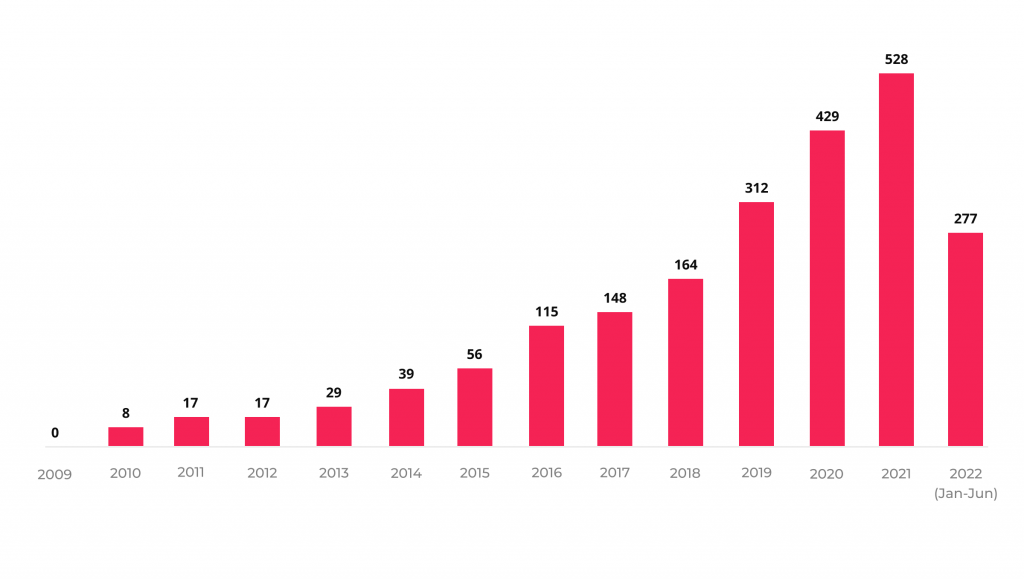
A particular checklist is needed to ensure your product hits the market. The same is true for telemedicine. Meeting the requirements of HIPAA (US) and GDPR (EU) can be challenging for any new telemedicine app. Besides, considering the growing number of cybersecurity in healthcare, the need for compliance is as high as ever (see Fig.3). So, you should consider compliance a fundamental challenge with the telehealth platform MVP you must overcome.
Digital Transformation
Innovation can be challenging since healthcare professionals and medical staff often find it hard to accept the new realities of working with digital tools. Also, data automation may be a massive leap from paper to electronic medical records (EMRs), which entails a steep learning curve. Finally, potential data security issues arise when people cannot adapt to digital transformation.
In such a context, compliance and resistance to digital transformation are two key challenges the healthcare app MVP brings. You must understand how to deal with these issues in advance. Otherwise, you will eventually face problems you cannot handle.
Step-by-Step Guide to Telemedicine App MVP Development
Before plunging into the steps below, you need to determine whether you need to go for the healthcare app MVP in the first place. Essentially, consider these factors:
- A low investment cap
- Desire to minimize financial risks
- Lack of clear idea whether an app will work out in the given market
- Need to validate the idea before further investment
- Calculated risk-taking approach to boost a chance of success
- It is your first healthcare app
If at least one of the factors above applies to your case, give the custom telehealth app MVP development a go. Now, let’s proceed with the steps needed to do that.

Step 1. Define the Critical Idea
The first step in telemedicine app MVP development is to define your idea behind the product and align it with current and future objectives. When you have a well-developed idea, it is time to share it with an experienced telemedicine software development company.
After that, the technical partner will help find the most fitting healthcare solutions to meet the business objectives behind the idea. It is the moment to decide whether you need complex tools like predictive analytics, or Artificial Intelligence (AI). The first step is to evaluate the overall feasibility of the idea behind the telemedicine app.
Let’s consider the given MVP model per the first development phase. Essentially, you need to align the idea with some basic app features. Later, during the final stages of development, if the testing of basic features pans out, it is the green light to think about some premium aspects.
Step 2. Explore the Competitors and Start a Discovery Phase
The next step is all about studying for the competition. It means you must look at custom telemedicine apps the rivals put on the market. Pay particular attention to what features in those apps are most loved by users. Competitive analysis is something you should not take with a grain of salt. Yet, keep in mind that you need to look at about ten basic features in the context of healthcare app MVP development.
While conducting a competitive analysis, ensure your vendor is not idle. During the first step, your chosen software development team should participate in a discovery phase. It means presenting a feasibility study on potential designs, tech stacks, and a roadmap for developing the telehealth platform MVP. Besides, it is time to select one of the APIs. Consider Twilio, Vidyo, and VSee SDK.
Step 3. List Potential Users and Behavior Patterns
The third development step is listing potential users, actions, and behavior patterns. When it comes to mHealth, understanding the outcome of user actions helps identify functional features. At this point, the step entails going through the telemedicine app MVP development process to establish the product’s app features set through these factors:
- Users. Define those who would use your product in groups.
- User actions. Determine their potential actions in the course of using the product.
- Behavioral patterns or action outcomes. Establish the patterns based on the actions to see the most and least functional features.
Besides, while you will likely need an EHR integration, determine how you can do that and choose the platform to work with early in the development solutions phase. Consider these EHR software solutions: Nimbo, Luma Health, RXNT, TigerConnect, Vectera, and Updox.
Step 4. User Interface (UI) Design
When you deal with an idea behind the product, see the feasibility study and consider user-to-feature correlation, it is time to proceed to product design management. In custom telemedicine app development, a good UI is vital for access to healthcare. It is a critical issue to resolve because hiring UI designers in North America is costly.
The solution is to outsource the UI development to key offshoring destinations. In such a context, Eastern Europe is the perfect destination. It grants the best cost-to-quality ratio in product development. In addition, to keep the costs of healthcare app MVP low, you must know what type of UI design you need. Consider checking on these aspects:
- MVP can deal without animated features
- Purchase interface elements like icons and buttons online
- Consider buying ready-made UI kits
- Emphasize a balanced view of personalization
At this point, you can save up to half of the MVP UI development cost. Remember to keep the design simple — an iOS app or Android version for an MVP can deal without heavy animations.
Step 5. MVP Deployment with Cross-Platform Focus
The next phase is to start the telehealth mobile app MVP deployment. Build the basic model with all pre-approved requirements and designs. Consider all the aspects of mobile and web development services and how deployment may differ based on the type of healthcare software.
During this stage, one of the critical aspects to consider is the focus on a cross-platform approach (like Flutter or React Native). It will be a product that runs on both iOS and Android. This approach is best because your developers will write and use one codebase for different platforms. As a result, it reduces the time and telemedicine app development cost.
Step 6. Focus on Quality Assurance (QA)
After the mobile app is deployed, it is time to test it. Make sure the product works with interruptions, as well as it is secure. The development team will review peer code during this phase, while QA testers will conduct unit testing. Yet, keep in mind that testing is not a one-time deal. You need to adopt it regularly, especially after each given update. Finally, do not forget about stress testing before the MVP’s release. This is vital for telehealth software development services to ensure the platform can handle the user influx without interruptions.
Step 7. Collect Feedback and Plan Updates
The final step is about learning from the app experience. In a nutshell, MVP is about how users perceive your product and try it in practice. Collect user feedback and turn it into actionable insights. These can be crucial for boosting the telemedicine app’s usability and features. With the telehealth platform MVP up and running, you can get user feedback via different channels.
For starters, consider these approaches:
- Pop-over surveys
- Feedback buttons
- In-app popups
- App rating prompts
- Embedded surveys
As a golden rule – keep all the surveys concise. Users don’t like spending too much time answering questions. Instead, they want to get their hands on the app’s features. Yet, to help meet their needs, you must consider what types of features your MVP will have. These insights are key to boost the custom telemedicine app’s usability for the new telemedicine app iteration.
Key Features for Custom Telemedicine App MVP Development
Your healthcare app MVP must have these basic features of telemedicine:

- User profile. This feature displays critical user data along with aspects like scheduled appointments and history of visits.
- Patient panel. This feature includes a list of doctors versus the list of health conditions to help you decide with which healthcare professional to schedule a visit.
- In-app calling. This feature includes a video consultation option, something like Zoom for Healthcare.
- In-app chat. This feature entails textual communication with a medical provider in case you do not want to use a video-calling tool.
- Geolocation. This feature helps you decide on healthcare professionals in your vicinity. It helps find the nearest hospital or provider for access to healthcare services.
- EHR/EMR. This feature grants medical professionals instant access to needed patient data to make diagnoses more accurate.
- Remote Patient Monitoring (RPM). This feature is needed for propagating patient self-monitoring. If a patient is pregnant or has some severe ongoing condition, self-monitoring offers constant updates helping a medical professional to prescribe appropriate health-related actions.
- Payment methods. This feature helps deal with all the financial transactions involved. Often, telemedicine services are paid with a credit card, coupons, employee coverage, or insurance.
- Symptom checker. This feature offers the user access to the knowledge base. It allows a person to define their symptoms and suggest a particular medical professional who appeals to them.
- Prescription tracker. This feature helps patients determine when and where to pick up their prescription from a pharmacy.
The basic features make the telemedicine app MVP functional enough for people to use it and basic enough to keep it low-cost.
What Are the Best Telemedicine Apps?
Now, it is time to offer some examples of what constitutes a good telehealth solution built by an experienced telemedicine software development partner In the course of healthcare app MVP development look forward to these telemedicine apps:
Consider the solutions above as examples of successful telehealth mobile apps. Yet, each of the mentioned products developed an MVP to increase the chance of success.
The Bottom Line
Telemedicine will continue to gain traction, making telehealth app development services more relevant than ever before. Keep in mind the challenges of HIPAA compliance and resistance to digital transformation. By finding a reliable software development partner, you can navigate the telemedicine application development process and launch a custom telemedicine app that will provide exceptional user experience and grow your business revenue.
Are you considering building a custom telehealth solution? Don’t settle for generic software. Message SPsoft to discuss how we can build a custom telemedicine app tailored to your specific clinical workflows!
FAQ
What is the average telemedicine app development cost for an MVP?
The telemedicine app development cost for a Minimum Viable Product (MVP) typically ranges from $40,000 to $100,000 in 2026. This price varies based on the number of app features, the choice of cross-platform versus native development, and the geographical location of your development team. For instance, a basic telehealth mobile app with video calls and scheduling might be on the lower end. Meanwhile, a custom telehealth solution integrated with complex EHR systems will increase the budget. Outsourcing to experienced telemedicine developers in Eastern Europe is a common strategy to maximize the cost-to-quality ratio.
How long does it take to develop a custom telemedicine app MVP?
The telehealth application development timeline for an MVP generally spans 3 to 6 months. This development process includes discovery, UI/UX design, backend development, and rigorous quality assurance. A more complex telemedicine application featuring AI-driven diagnostics or extensive remote patient monitoring (RPM) tools may take up to 9 months. Utilizing pre-built software tools and telemedicine software solutions like Twilio for video can help speed up the new telemedicine app launch.
What are the main challenges of telemedicine software development?
The biggest challenges in telemedicine software development are HIPAA/GDPR compliance, data security, and EHR integration. Ensuring that sensitive information is protected during a video call or real-time interactive telemedicine session requires advanced encryption and secure cloud infrastructure. Additionally, overcoming resistance to digital transformation among healthcare professionals and ensuring interoperability between the telehealth software and various medical devices are critical hurdles to address throughout the development process.
Why is EHR integration essential for custom telehealth apps?
EHR integration is essential because it allows for a seamless flow of patient data between the telemedicine platform and the hospital’s primary records. For a healthcare provider, this means no manual data entry is required after a video call, reducing errors. For patients, it ensures that their medical history is available to the doctor in real-time, leading to better patient care and more accurate prescriptions. Integration is a cornerstone of any successful healthcare mobile app development project.
What features should a custom telemedicine app for doctors include?
A custom telemedicine app designed for doctors should include a robust patient appointment management system, calendar management, and the ability to generate e-prescriptions. It also requires EHR integration for instant patient information management and secure consultation recording features. Push notifications for upcoming appointments and a verification system for practitioner licenses are vital telemedicine software features enhancing the provider experience.
Can I build a custom telemedicine app using cross-platform frameworks?
Yes, using cross-platform frameworks like Flutter or React Native is highly recommended for telemedicine mobile app development. This approach allows you to build a custom telehealth mobile app for both iOS and Android using a single codebase. This reduces telemedicine app development cost and time while ensuring a consistent app experience for users. Most custom telemedicine app development projects prioritize this model to reach the widest audience.
What is the role of remote patient monitoring (RPM) in a telehealth app?
Remote patient monitoring (RPM) allows healthcare providers to track the patient’s vitals (like heart rate, blood pressure, or glucose levels) in real-time using connected medical devices. In a telehealth application, RPM provides continuous data that helps in managing chronic conditions or post-surgical recovery. This leads to preventive health interventions before a condition worsens, making the telemedicine solution more proactive and valuable.
How do I choose the right telemedicine app development company?
To choose the right telemedicine app development company, look for a development partner with a proven track record in healthcare software development services. They should have deep expertise in HIPAA regulations, interoperability standards (HL7/FHIR), and UI/UX for healthcare. Evaluate their portfolio for successful healthcare mobile app development projects and check if they provide long-term maintenance services. A reliable software development partner will act as a consultant, helping refine a custom telehealth solution from the discovery phase to launch.