
The insurance industry is profoundly transforming from traditional, static risk assessment models to more dynamic, personalized approaches. Technological advancements and changing consumer expectations drive this shift. Behavior-based insurance (BBI) is at the forefront, an innovative model poised to fundamentally alter life and health plans by linking coverage to individual lifestyles and actions.

Insurers increasingly incorporate real-time behavioral data, a paradigm shift from older methods. Given practical and ethical hurdles, this article examines whether behavior-based insurance will revolutionize life and health coverage or if its potential is overstated. While BBI offers exciting prospects, its path to widespread adoption, especially in life and health, is complex. The re-evaluation of “risk” as a dynamic, individualized behavior is central to this evolution.
The rise of behavior-based insurance presents new opportunities and challenges. SPsoft’s expertise in developing and integrating AI agents can empower insurers to navigate this landscape effectively!
Decoding Behavior-Based Insurance: More Than Just Data
Behavior-based insurance (BBI) adjusts premiums, rewards, or policy terms based on an individual’s observed behaviors. It uses data on habits and lifestyles to create a more accurate, dynamic, and personalized risk profile, unlike traditional insurance, which relies on historical averages.
A key goal of behavior-based insurance is to incentivize positive behaviors. In auto insurance, this means rewarding safe driving. Life and health insurance involve encouraging regular physical activity, healthy eating, and preventive care. By offering benefits like lower premiums, BBI aims to motivate policyholders to adopt risk-reducing behaviors. That marks a departure from traditional models, now augmented by behavioral data. Granular data from telematics and wearables enables this individualized assessment.
BBI vs. UBI (Usage-Based Insurance): Clearing the Confusion
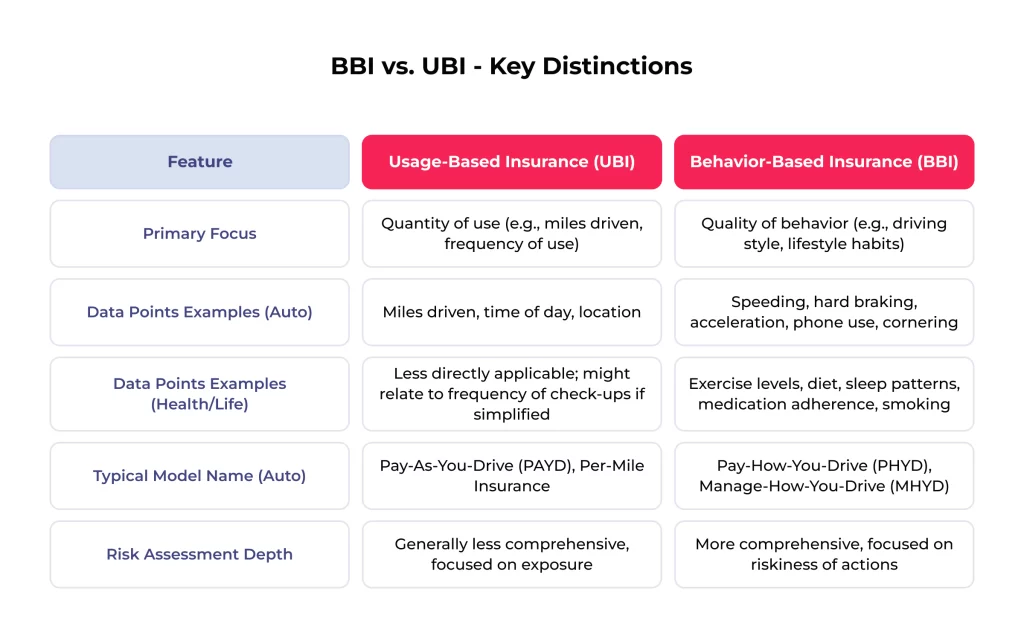
Though often confused, behavior-based insurance (BBI) and usage-based insurance (UBI) differ. UBI mainly considers how much or when an asset is used (e.g., Pay-As-You-Drive based on miles driven).
Behavior-based insurance focuses on an individual’s behavior (e.g., Pay-How-You-Drive, analyzing driving habits like speed and braking). For life and health, BBI assesses lifestyle choices like exercise and diet. BBI offers a more nuanced risk assessment by evaluating the quality of behavior, not just usage quantity. This distinction is vital for behavior-based insurance for health plans, where lifestyle is a key risk indicator.
How Does Behavior-Based Insurance Work in Practice?
A typical behavior-based insurance program involves:
- Data Collection. Behavioral data is gathered from policyholders. Auto insurers use telematics devices or smartphone apps. For health behavior-based insurance and life insurance, data comes from wearables, health apps, and IoT health monitors, capturing activity, sleep, and heart rate.
- Data Analysis & Risk Profiling. Insurers use AI and ML to process this data, creating a dynamic, individualized risk profile updated with new behavioral information. That offers a richer risk understanding than traditional factors.
- Premium Adjustment/Rewards. Based on the risk profile, insurers adjust premiums or offer rewards. Safe drivers or healthy individuals often receive lower costs or other benefits. USAA’s SafePilot, for example, offers discounts for safe driving.
- Feedback Loop. Many behavior-based insurance programs provide feedback, showing policyholders their scores, how actions impact risk, and improvement suggestions. That empowers positive changes, making the insurance relationship more collaborative, especially for health behavior-based insurance.
The Ascent of BBI in Life and Health Insurance
While BBI started in auto insurance, its principles are increasingly applied to life and health insurance, driven by evolving consumer expectations, tech advancements, and the appeal of personalized, proactive well-being.

Market Drivers: Consumer Demand and Technological Maturity
Strong market drivers fuel the rise of health behavior-based insurance. Consumers increasingly seek affordable, personalized insurance, with 50-70% willing to share health data for benefits and 60-75% preferring BBI options.
Technologically, AI-powered analytics, IoT devices, and wearables provide the necessary infrastructure. While AI analytics and IoT are maturing, Gartner’s Hype Cycle suggests comprehensive “panoptic personalization” for life and health. BBI may take over ten years for mainstream adoption. Simpler BBI offerings are emerging, but the fully integrated vision is still developing, despite consumer readiness. The success of UBI in motor insurance hints at a similar, though potentially more complex, path for BBI in health insurance.
The Allure of Personalized Premiums and Proactive Health Management
Health behavior-based insurance appeals to consumers with premiums reflecting individual health efforts, offering fairness and control. Beyond cost savings, it encourages proactive health management by linking financial incentives to healthy choices like exercise, nutrition, and preventive care. This model promises fairer costs and minimized risks, shifting focus from indemnifying illness to promoting health.
Behavior-Based Insurance for Health Plans: A New Paradigm
BBI in health insurance promotes wellness by linking financial incentives to healthy habits, fostering a collaborative insurer-insured partnership for better health outcomes. This proactive approach can improve population health by reducing chronic, lifestyle-related diseases. ScienceSoft predicts BBI adoption could cut annual premiums by up to 40% for health-conscious individuals. Value-Based Insurance Design (VBID) aligns with this, using incentives for high-value medical services and proactive health management.
Examples of Incentives in Health Behavior-Based Insurance Programs
Health behavior-based insurance programs use various incentives:
- Financial Rewards. Gift cards for wellness screenings or health assessments.
- Premium Reductions. Lower premiums for achieving health goals (e.g., step counts, weight loss).
- Discounts. On gym memberships, fitness classes, or healthy meal plans.
- Reduced Cost-Sharing. Lower copayments for preventive medications.
- Points-Based Systems. Points for healthy activities redeemable for rewards.
Encouraging Longevity: How BBI is adapting for life products
Behavior-based insurance (BBI) enters life insurance, moving beyond static risk factors by rewarding ongoing healthy behaviors that promote longevity. BBI in life insurance incentivizes choices like regular exercise, good nutrition, and preventive checks, reframing life insurance as a product supporting a longer, healthier life. Behavioral economics informs program design, offering immediate rewards for healthy choices.
Spotlight on Innovators: Life Insurers with BBI-linked Wellness Programs
Several life insurers have integrated behavior-based insurance through wellness programs, often partnering with platforms like “Vitality”:
- John Hancock (USA). The Vitality Program rewards healthy activities with premium savings (up to 25%), discounted wearables (Apple Watch, Fitbit), and healthy food savings.
- Manulife (Canada). Manulife Vitality offers points for healthy habits, leading to premium savings (up to 15%), brand discounts, and subsidized Apple Watches.
- AIA (Australia, Asia). AIA Vitality provides points for healthy choices, unlocking lower premiums and partner discounts (Peloton, New Balance).
- Generali (Europe). Generali Vitality motivates healthier living with rewards from partners like Adidas and Expedia.
These programs show a global trend towards life insurance that actively promotes healthy living.
Technologies Fueling BBI in Health Insurance
Successful behavior-based insurance for health plans relies on a sophisticated technological infrastructure.
Wearables and IoT: Constant Companions in Data Gathering
Wearables (fitness trackers, smartwatches) and IoT devices are primary data collectors for health behavior-based insurance. They capture real-time data on physical activity, sleep, heart rate, and other lifestyle metrics. These consumer-owned devices lower entry barriers for data collection. IoT ensures seamless data flow, enabling continuous monitoring for dynamic risk assessment.
AI and Machine Learning: The Intelligence Layer for Behavior-Based Insurance
AI and ML are the “brains” of behavior-based insurance. They analyze vast data from wearables and IoT for:
- Pattern Recognition. Identifying behavioral and health trends.
- Anomaly Detection. Spotting unusual changes indicating health risks.
- Risk Prediction. Developing accurate risk models based on behavior.
- Personalization. Tailoring feedback, incentives, and products.
Gartner identifies AI/ML as a top transformative technology in insurance. Emerging AI, like LLMs, is expected to significantly impact healthcare payers within 2-5 years. The sophistication of these models drives the viability of BBI in health insurance.
mHealth Applications: Engaging Policyholders
Mobile health (mHealth) apps are the primary interface for behavior-based insurance for health plans, enabling:
- Data Input/Synchronization. Logging activities or syncing from wearables.
- Progress Display. Dashboards for tracked behaviors and rewards.
- Wellness Content Delivery. Educational resources and health tips.
mHealth apps foster continuous engagement, shifting the insurer-policyholder interaction from infrequent to potentially daily. User experience is critical for program success.
Will BBI Truly Reshape Life & Health Plans?
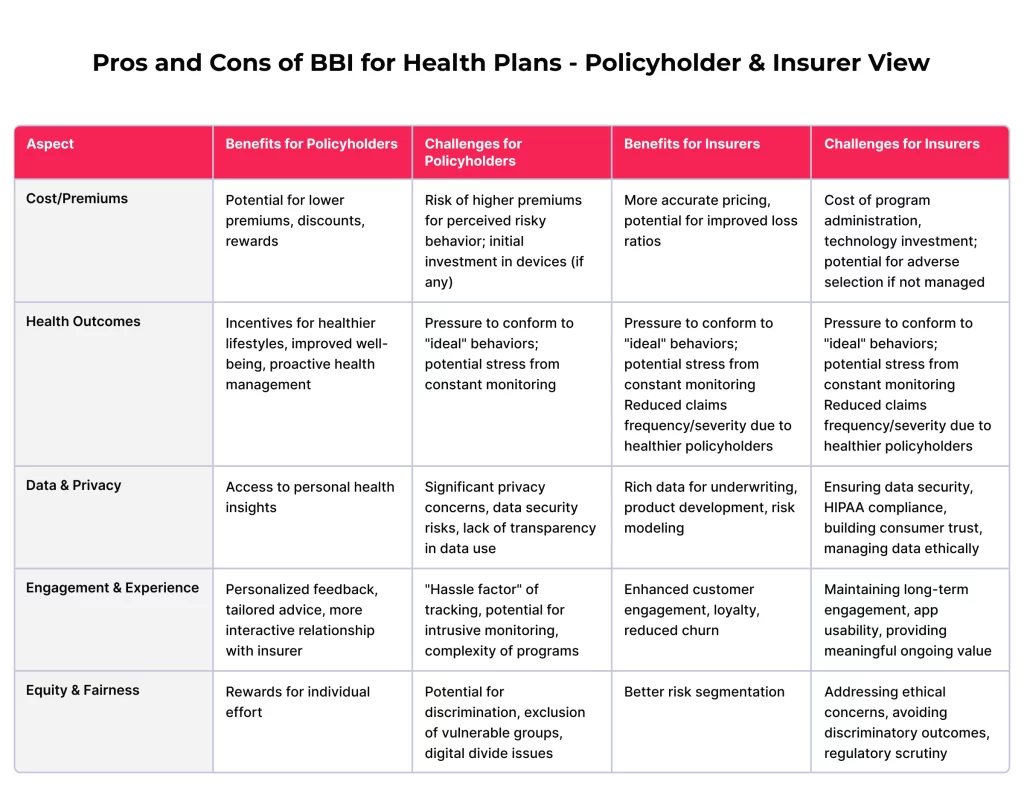
Behavior-based insurance holds promise, but its capacity to reshape life and health plans depends on balancing benefits against practical and ethical challenges.

The Bright Side: Unpacking the Benefits of BBI
Behavior-based insurance offers advantages for participants:
- Empowerment and Control. Greater agency over insurance costs and health.
- Significant Cost Savings. Potential for premium reductions (up to 40% in some health BBI programs) and financial rewards.
- Improved Health and Wellness. Incentives encourage healthier habits, improving well-being.
- Personalized Experience. Tailored advice, feedback, and products.
- Enhanced Health Awareness. Better understanding of personal health patterns.
Insurers also benefit from behavior-based insurance:
- More Accurate Risk Assessment and Pricing. Precise underwriting using real-time behavioral data.
- Reduced Claims Frequency and Severity. Incentivizing healthier lifestyles can lower claims.
- Enhanced Customer Engagement and Loyalty. Frequent interactions build stronger relationships.
- New Product and Service Innovation. Opportunities for personalized products and value-added services.
- Shift to Proactive Risk Management. Moving from risk transfer to active risk prevention.
The Hurdles: Navigating the Challenges of BBI in Health Insurance
Widespread adoption of behavior-based insurance for health plans faces significant hurdles.
The Data Conundrum: Privacy, Security, and Trust
Behavior-based insurance relies on vast, sensitive personal data, raising privacy and security concerns, especially for health behavior-based insurance.
- Privacy. Consumers worry about data use and access. Transparency is key.
- Security. Protecting data from breaches is critical, governed by regulations like HIPAA.
- Trust. Adoption hinges on trust in responsible data handling. Opaque algorithms can erode trust.
Ethical Tightropes: Fairness, Discrimination, and the Digital Divide
Ethical implications of behavior-based insurance include:
- Fairness and Discrimination. BBI models could potentially discriminate or perpetuate inequalities, possibly through “proxy discrimination.”
- Exclusion and Affordability. Risk of “high-risk” individuals facing unaffordable premiums or denial of coverage.
- Digital Divide and Accessibility. BBI in health insurance often requires technology access, potentially excluding some individuals.
- Moralizing Behavior. Risk of creating a divide between “responsible” and “irresponsible” individuals.
Regulators must balance innovation with consumer protection.
Consumer Adoption and Behavioral Economics
Consumer adoption isn’t guaranteed. Behavioral economics highlights:
- Choice Overload and Complexity. Complicated BBI plans may deter enrollment.
- Behavioral Biases. Loss aversion, status quo bias, and present bias can influence decisions.
- Behavioral Hazard. Psychological biases might lead to underuse of high-value care or suboptimal engagement with BBI programs, even with rewards.
The perceived value proposition is crucial for adoption.
The Future of Behavior-Based Insurance in Life and Health
Behavior-based insurance is poised for a significant role in life and health insurance, with optimistic market projections and ongoing technological advancements. However, full maturity for sophisticated BBI in health insurance will take time.
Market Trajectory: Growth Projections and Expert Forecasts
The broader data-driven insurance market shows robust growth:
- Usage-Based Insurance (UBI) Market. Projected to reach $70.46 billion by 2030 (MarketsandMarkets) or $267.4 billion by 2032 (Allied Market Research).
- Wellness and Activity-Based Health Insurance Market. Valued at $97 billion in 2022, projected to reach $302.1 billion by 2032 (Allied Market Research).
- Digital Health Market. Forecasted to reach $549.7 billion by 2028 (MarketsandMarkets).
North America is a leading market. Key drivers include demand for personalization, connected device penetration, and health awareness. However, Gartner suggests a 10+ year timeline for mainstream adoption of advanced “panoptic personalization” in life and P&C insurance. That indicates an evolutionary process for comprehensive BBI in health insurance.
The Evolving Role of AI in Shaping Future Insurance Models
AI will be pivotal in advancing behavior-based insurance:
- Hyper-Personalization. AI, including LLMs, will enable highly personalized experiences.
- Predictive Analytics. AI models will better predict health risks for proactive interventions.
- Enhanced Engagement. LLMs could power sophisticated conversational AI for support and coaching.
- Operational Efficiency. AI-driven hyperautomation will streamline processes.
Ethical AI development and governance are crucial. Explainable AI (XAI) will be vital for trust and regulatory compliance.
So, Reshaping or Reimagining? The Verdict on BBI’s Impact
Behavior-based insurance points towards a fundamental reimagining of insurance, especially for life and health plans. The shift from reactive claims payment to proactive wellness partnerships is a paradigm change. The potential for BBI in health insurance to improve public health underscores its transformative capacity.
While significant hurdles remain, strong underlying drivers — consumer demand and technological feasibility — suggest continued progress. Balancing innovation with responsibility is key for inclusive and equitable models.
Conclusion
Behavior-based insurance can revolutionize life and health insurance through hyper-personalized coverage and proactive wellness. For consumers, it offers lower premiums and better health; insurers offer more accurate risk assessment and customer loyalty.
The question “Will it truly reshape life and health plans?” leans towards “yes, with critical caveats.” Behavior-based insurance, particularly BBI in health insurance, can reimagine these sectors. Success depends on addressing data privacy, ensuring fairness, guarding against discrimination, and evolving regulatory frameworks.
This journey requires collaboration. Insurers must innovate responsibly. Technology providers like SPsoft are crucial for developing intelligent, ethical AI solutions. Regulators need to provide adaptive oversight, and consumers need education. The goal is to harness BBI’s power for a system that is efficient, personalized, equitable, accessible, and supportive of well-being. Trust, built on ethical frameworks and transparency, is paramount.
The journey to BBI is complex but promising. SPsoft is at the forefront of developing intelligent AI solutions that can power the next generation of healthcare insurance!
FAQ
Is behavior-based insurance just for super-healthy people?
Not necessarily. While behavior-based insurance rewards healthy habits, many programs aim to support individuals in making positive changes, offering tools and incentives for improvement, regardless of their starting point. The goal is often progress, not perfection.
Will my personal health data be safe with behavior-based insurance?
Reputable insurers and their tech partners are bound by strict data privacy laws (like HIPAA in the U.S.) and ethical guidelines. Transparency about data use and robust security measures are crucial. Always review the insurer’s privacy policy.
Can BBI really lower my health or life insurance costs significantly?
Yes, for many people. By demonstrating consistent healthy behaviors, policyholders can earn substantial premium discounts (some reports suggest up to 40% for health BBI) and other rewards. Savings vary by program and individual engagement.
What kind of behaviors does health BBI actually track?
Typically, health behavior-based insurance tracks activities like daily steps, regular exercise, sleep patterns, participation in wellness programs, preventive screenings, and sometimes even nutrition habits through connected apps and wearables.
Is behavior-based insurance the same as usage-based insurance (UBI)?
No. UBI usually focuses on how much you use something (like miles driven for car insurance). Behavior-based insurance (BBI) focuses on how you behave (e.g., safe driving habits, healthy lifestyle choices). BBI is generally more comprehensive in its risk assessment.
Do I need to buy expensive gadgets to participate in health BBI?
Often, no. Many BBI in health insurance programs can sync with popular existing fitness trackers or smartphone apps you might already use. Some insurers might offer discounted devices as part of the program.
What are the main downsides or concerns with behavior-based insurance?
Key concerns include data privacy and security, the potential for unfair discrimination if models aren’t designed carefully, and ensuring equitable access for individuals who may lack technology or face socio-economic barriers to healthy living.
How is AI used in behavior-based insurance for health plans?
AI is crucial for analyzing the large volumes of behavioral data collected, identifying health risks and patterns, personalizing feedback and rewards, and helping insurers price policies more accurately for behavior-based insurance for health plans.
Is BBI becoming common for life insurance too?
Yes, it’s a growing trend. Life insurers are using behavior-based insurance principles to reward policyholders for healthy lifestyles that can lead to longer lives, offering benefits like premium savings and wellness rewards through programs like John Hancock Vitality.
Where is behavior-based insurance headed in the future?
Expect more personalization, greater integration of AI (like LLMs) and IoT, a stronger focus on preventive health, and evolving regulations. The aim is to make insurance more proactive, engaging, and tailored to individual needs and actions.