
Managing data effectively is more critical than ever in our increasingly digital healthcare world. That is where healthcare data warehousing comes into play, providing a centralized hub for storing, processing and analyzing vast amounts of information. In an era dominated by big data, a medical facility cannot rely on fragmented, siloed structures to drive modern patient outcomes.

This field is experiencing rapid growth. According to a report by MarketsandMarkets, the global healthcare analytics market, encompassing data warehousing and advanced intelligence engines, is projected to soar to $50.5 billion by 2024, a significant jump from $14 billion in 2019. This surge underscores the growing reliance on data-driven strategies in the healthcare industry. In this article, we will dive into clinical data storage systems, discussing its advantages, key structural features, and a roadmap for enterprise implementation.
Are you ready to unify your enterprise health data? Contact SPsoft to learn how our engineering specialists can architect a high-performance healthcare data warehouse tailored to your organization’s precise clinical and operational needs!
Table of Contents
“In the dynamic field of healthcare data management, our goal is to lead with innovation and efficiency. Our healthcare data warehousing solutions catalyze smarter, patient-centered care. At SPsoft, we’re bridging the gap between data potential and healthcare excellence.”
Mike Lazor
CEO, SPsoft
“We understand the power of data in transforming healthcare. Our dedicated team crafts data warehousing solutions that store information and turn it into actionable insights. We’re committed to providing tools that empower healthcare professionals to make informed decisions for better patient outcomes.”
Romaniya Mykyta
Head of Product Management, SPsoft
What Healthcare Data Warehousing Is All About?
A centralized healthcare data warehouse deals with an extensive volume of medical data. This innovative solution supports crucial clinical and operational decision-making processes by gathering data from a diverse range of data points. A data warehouse is a centralized repository that integrates clinical, financial, and operational information. It gives healthcare providers a detailed view of patient care and operational efficiency, enabling more informed decisions.
To put it in perspective, a clinical or enterprise data warehouse is all about:
- Integration of diverse data sources. Gathering info from Electronic Health Records (EHRs), radiology images, laboratory results, and wearable technology.
- Centralized storage of comprehensive patient information. Organizing histories, treatment plans, and clinical outcomes across multiple distinct departments.
- Accessibility to different healthcare professionals. Facilitating a holistic view of the patient’s health journey to enhance the quality of patient care.
Furthermore, an enterprise data warehouse in healthcare can easily include operational records such as staffing levels, supply chain assets, and patient flow metrics. A study from the Journal of Medical Internet Research indicates that the adoption of a robust data platform can lead to a reduction in patient wait times and a great increase in hospital operational efficiency. A robust data warehouse is a repository that transforms scattered inputs into an active strategic asset.
The Healthcare Data Warehouse Market Highlights
The data warehouse healthcare sector is experiencing a remarkable transformation, driven by several key factors reshaping its landscape. The explosive growth in the baseline volume of healthcare data is at the core of this evolution. This trend necessitates advanced architectural designs for adequate storage, management, and downstream data analysis.
Rapid Growth Due to Increasing Healthcare Data Volume
Without a doubt, the ongoing widespread adoption of electronic health records, wearable health devices, and telemedicine applications has led to an extraordinary surge in data generated daily. According to a report by IDC, the importance of health data was projected to experience a CAGR of 36% through 2025, which is faster than in most other commercial industries. This massive influx requires a robust data warehouse solution capable of handling such petabyte-scale volumes efficiently.
Focus on Improving Patient Outcomes and Operational Efficiency
Additionally, there is a heightened focus across the board on improving patient outcomes and overall operational efficiency. An enterprise data warehouse plays a critical role by enabling providers to aggregate, clean, and map clinical entries. This level of data integration allows for more informed decision-making. For instance, analyzing historical patterns in patient admissions directly leads to optimized clinician staffing and better emergency room resource allocation.
Integration of Advanced Analytics and AI Technologies
Integrating advanced healthcare analytics and artificial intelligence (AI) technologies into a clinical data warehouse has further propelled its capabilities. These technical stacks allow for sophisticated data mining, predictive modeling, and real-time decision support.
For example, AI algorithms can evaluate data from a wide variety of external data sources to accurately predict immediate patient health risks, assisting in preventative care measures. A study published in The Lancet Digital Health Journal highlighted the potential of AI in predicting acute outcomes based on structured EHR datasets. Also, it underscores the transformative impact of these combined technologies in the healthcare industry.
The Architecture of a Healthcare Data Warehouse
The architecture of an enterprise data warehouse in healthcare is a complex yet meticulously structured multi-layered framework. It is designed to safely ingest, process, and analyze massive volumes of medical data, covering several critical components, each serving an essential role in the overall pipeline.

Diverse Data Sources (The Ingestion Layer)
The foundation of a healthcare data warehouse lies in its data source layer, which typically gathers info from:
- Electronic Health Records (EHRs) and clinical charts
- Hospital billing software and financial data streams
- Patient management systems and registration logs
- Laboratory information systems and pathology reports
Integrating these various inputs allows for an all-encompassing view of healthcare operations. The warehouse integrates data from multiple endpoints, bridging the gap between clinical action and business analytics.
Data Staging Area (The ETL Pipeline)
A critical component of this architecture is the data staging area. Here, raw data extracted from different systems is consolidated, cleansed, and organized before being permanently committed to the data storage layer. This data integration process involves complex tasks like normalization, where data formats are standardized, and data validation to guarantee absolute data accuracy. It transforms raw data into structured, analytical-ready formats.
Central Data Repository (The Storage Core)
The heart of the system is the central repository, where clean, processed data is securely committed. Whether configured as a structured clinical data warehouse or paired with a scalable data lake for unstructured files, this core is designed for high performance. It handles a vast amount of data while safeguarding data integrity. Technologies like relational SQL databases or cloud-native columnar data warehouses are commonly deployed here.
Data Marts for Departmental Needs
A data mart is a specialized subset of the central repository, specifically tailored to meet the localized analytical needs of a particular department within a healthcare organization. For example, a finance department might access a specific data mart containing insurance claim workflows. Meanwhile, the clinical department utilizes individual data marts focusing on patient treatment histories and diagnostic results. These targeted subsets enable teams to pull accurate data rapidly without querying the entire corporate database.
Advanced Analytical Tools
Analytical layers are integrated directly into the system, enabling healthcare professionals to query, report, and evaluate stored data. These range from basic query interfaces to sophisticated predictive analytics models. Tools like Tableau or Power BI can connect to the warehouse to build interactive dashboards, helping teams identify critical trends, execute data-driven workflows, and directly improve patient care outcomes.
The architecture of healthcare data storage is a robust, well-orchestrated system critical in healthcare analytics and decision-making. Its ability to integrate and process data from multiple sources and advanced analytical capabilities make it an indispensable asset in modern healthcare operations.
Healthcare Data Warehousing Benefits
Deploying a structured medical data warehouse acts as a powerful catalyst across an organization’s ecosystem. The operational benefits of healthcare data warehousing extend far beyond basic storage.

Enhanced Decision-Making
A comprehensive clinical data warehouse provides administrators and clinicians with a clear, holistic view of historical and real-time operations. For example, by connecting historical patient medical records with longitudinal treatment outcomes, a healthcare data warehouse provides the objective insights needed to establish the most effective clinical paths. This integrated data eliminates guesswork and supports evidence-based leadership.
Improved Patient Care Through Predictive Analytics
Healthcare data warehousing enhances direct treatment strategies by unlocking the power of predictive clinical analytics. By analyzing data historical and current simultaneously, the system:
- Forecasts individual patient outcomes and potential post-surgical complications
- Identifies specific risk factors for chronic cardiovascular or metabolic conditions
- Suggests early preventative interventions to avoid emergency readmissions
- Builds highly customized, targeted treatment plans based on comprehensive profiles
This allows healthcare providers to shift from a reactive treatment model to a proactive, preventative approach.
Cost Efficiency and Resource Optimization
A consolidated view of an individual’s history can quickly eliminate redundant or repetitive diagnostic tests across different departments. This directly saves hospital expenses and improves the overall healthcare experience for the patient. Furthermore, analyzing trends within the data storage system helps management optimize everything from nursing schedules to pharmaceutical inventory levels.
Regulatory Compliance and Data Security
An enterprise data warehouse assists in complying with strict industry regulations by providing highly structured, traceable data. Having a verified data governance model ensures that all actions leave a transparent trail, which is crucial for external audits and quality assurance programs. With advanced encryption protocols, the warehouse guarantees data protection while strictly aligning with HIPAA and GDPR mandates.
Research and Development
The massive volume of consolidated information within a clinical data warehouse is highly valuable for academic and clinical research. Investigators can access anonymized data sets for deep epidemiological studies, leading to clinical breakthroughs. Furthermore, pharmaceutical research benefits heavily from having access to longitudinal, real-world data, facilitating faster drug discovery and more efficient clinical trials.
The benefits of data warehousing extend far beyond mere data storage, fundamentally transforming the landscape of healthcare services.
Key Components of a Healthcare Data Warehouse
A healthcare data warehouse is built with advanced capabilities designed to handle the specific security and operational challenges of the medical field.

Scalable Storage Layer
One of the primary features of a healthcare data warehouse is its scalable storage capacity, which is essential to accommodate the continuously growing volumes of healthcare information. This scalability ensures the system can handle increasing data loads without degradation.
As healthcare facilities expand and evolve, scalable storage allows for adding new data types and sources, such as genomics data or new medical imaging formats. What is more, it does not require a complete overhaul of the existing data warehouse infrastructure.
High-Performance Analytics
High-performance analytics enable the processing and analysis of large datasets in real time. That is crucial for time-sensitive applications like patient monitoring and emergency response, where immediate data analysis can be life-saving. With high-performance analytics, healthcare providers can perform complex tasks, like trend analysis and predictive modeling, aiding in proactive healthcare management and decision-making.
Robust Security Protocols
Robust security measures are essential in health data warehouses due to the sensitive nature of patient health information. Here is an overview:
- Ensuring sensitive patient health information or PHIs are well-protected
- Implementing encryption to secure data from unauthorized access
- Establishing access controls to manage data accessibility
- Conducting regular security audits to identify existing threats and prevent future ones
- Protecting data against unauthorized access and minimizing potential data breaches
- Recognizing the non-negotiable need for robust security in healthcare data management
Robust security also ensures compliance with health data regulations such as HIPAA in the US. Thus, the patient data is handled in a manner that respects privacy and confidentiality.
Interoperability Engines
A key feature of a health data warehouse is its ability to seamlessly integrate with various healthcare systems, such as EHRs, billing, and laboratory information systems. This interoperability is critical for ensuring that data across different healthcare domains is consolidated effectively.
Interoperability involves standardizing data formats and protocols (like HL7 or FHIR) and facilitating smooth data exchange and aggregation from diverse healthcare apps and devices.
User-Friendly Interfaces
The complexity of healthcare data analysis requires a user-friendly interface allowing healthcare professionals to navigate, query, and interpret data efficiently. User-friendly interfaces often include customizable dashboards and reporting tools. This enables patients to tailor data visualization and reports to their specific needs, enhancing the usability of the data warehouse.
Collectively, the mentioned features enable healthcare organizations to manage their data seamlessly, make informed decisions, and improve patient care.
Use Cases of Data Warehouse Storage
Modern medical networks leverage their data platforms across multiple practical domains to drive daily value.
Predictive Analysis for Patient Care
By compiling data from various sources, a clinical data warehouse can run machine learning models to identify high-risk populations. For instance, evaluating historical trends across millions of combined records can help predict which diabetic patients are at the highest risk for renal complications. This allows care teams to intervene early.
Financial Reporting and Cost Analysis
A medical data warehouse consolidates financial information with clinical data, helping leaders discover operational inefficiencies. By analyzing the exact cost of specific surgical procedures across different care teams, hospitals identify areas of waste and standardize data workflows to deliver cost-effective treatments without sacrificing quality.
Clinical Research Data Management
When conducting extensive clinical trials, managing a massive amount of data securely is a major challenge. A data warehouse serves as a centralized, structured repository where researchers can securely compile data for clinical tracking, cross-reference patient outcomes, and easily verify the safety and efficacy of novel therapeutic interventions.
Operational Efficiency Tracking
Hospitals rely on data warehouses to track complex metrics like average emergency department stay, bed turnover rates, and inpatient flow. This real-time data visualization enables shift managers to adapt to changing volumes, balance clinical workloads, and ensure that hospital assets are deployed efficiently.
Data storage in healthcare are versatile tools that enhance patient care through predictive analysis, refine financial management, bolster clinical research, and many more. These use cases underscore their integral role in elevating the healthcare industry’s capabilities.
A Healthcare Data Warehouse Implementation Roadmap
Building a data warehouse for an enterprise healthcare network requires a structured, multi-phase technical roadmap.
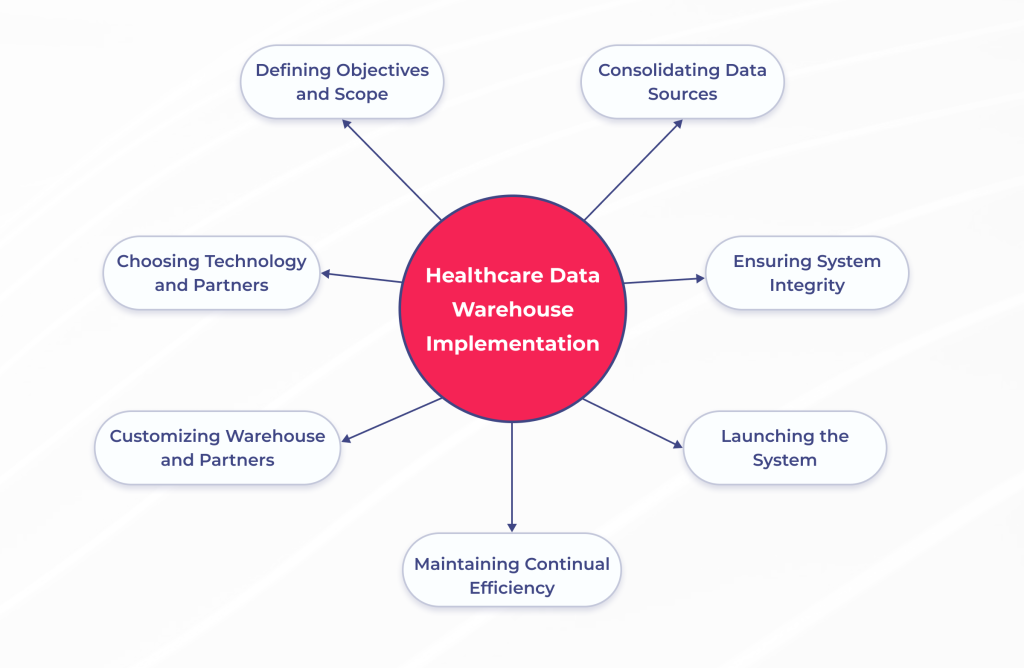
Step 1. Defining Objectives and Scope
Begin by defining what you aim to achieve with the data warehouse. That means understanding the specific healthcare data management needs, such as improving patient care or streamlining operational processes. Determine the scope of the project, including which data sources will be integrated, the scale of data to be handled, and the key performance indicators (KPIs) to track.
Step 2. Choosing Technology and Partners
Select the appropriate tech stack that aligns with your healthcare data needs. That includes choosing databases, ETL (Extract/Transform/Load) tools, and analytics platforms. Identify and collaborate with tech vendors with proven experience in healthcare software development.
Step 3. Customizing Warehouse Architecture
Design a warehouse architecture that suits your healthcare organization’s specific needs. That includes determining how data will be stored, processed, and accessed. Create the warehouse by constructing the database, setting up ETL processes, and configuring the analytical tools.
Step 4. Consolidating Data Sources
Integrate data sources such as EHRs, billing, and patient management systems into the data warehouse. Establish processes to cleanse and validate data as it is integrated, ensuring high data quality and consistency.
Step 5. Ensuring System Integrity
Test the data warehouse thoroughly to ensure that it functions correctly, data is accurately represented, and performance meets expectations. Evaluate the system against predefined KPIs to ensure it meets the objectives and provides accurate, efficient data handling.
Step 6. Launching the System
Roll out the data warehouse system across your healthcare organization. Provide complex training to staff and users, ensuring they can utilize the system effectively.
Step 7. Maintaining Continual Efficiency
Regular updates and maintenance are crucial to ensuring the effectiveness of a data storage and warehousing system. Let’s have a closer look:
- Implementing regular updates to stay aligned with the latest tech advancements
- Adapting the system to meet evolving healthcare data requirements
- Providing ongoing maintenance to ensure the system runs smoothly
- Offer continuous support to address any issues that arise quickly
- Optimizing system performance for maximum efficiency and reliability
- Adapting to changing needs in the healthcare data landscape
This approach ensures the system remains robust, efficient, and responsive to the dynamic nature of healthcare data management. By following the roadmap above, organizations can improve data-driven decision-making and overall patient care.
Final Thoughts
Adopting an advanced healthcare data warehouse is a foundational commitment to the future of intelligent, connected medicine. By empowering your organization to securely store, integrate, and analyze its vast wealth of data, you move beyond simple record-keeping to establish a truly predictive ecosystem. In an era where data-driven clarity defines clinical success, investing in a robust, scalable warehouse is the ultimate mechanism. This will help achieve superior patient care, secure financial performance, and drive long-term institutional growth.
Are you considering reaching the true potential of your healthcare data? Contact SPsoft to discuss your data architecture goals, and let our specialized engineers build a secure, compliant data warehouse that powers your digital future!
FAQ
What is the simple definition of a healthcare data warehouse?
A healthcare data warehouse is a highly specialized, centralized computer data system. It is designed to securely aggregate, organize, and store vast volumes of health data collected from various data sources across an organization. Unlike a standard transactional database that only records daily activities, a data warehouse optimizes historical data for downstream healthcare analytics and business intelligence. By executing a thorough data integration process, it can connect disconnected applications into a single repository to support strategic decision-making.
How does an enterprise data warehouse differ from a clinical data warehouse?
The difference lies primarily in the technical scope of the data stored within the platform. A clinical data warehouse focuses primarily on medical and treatment metrics, such as patient medical histories, diagnostic lab results, and therapeutic outcomes. On the other hand, an enterprise data warehouse takes an all-encompassing approach, integrating clinical data with the organization’s entire operational and financial footprint. This includes supply chain metrics, hospital financial data, HR records, and administrative workflows.
Why is data quality a critical concern during the data integration process?
Data quality is paramount because a clinical data warehouse directly influences patient care decisions and hospital operational planning. During the initial staging phase, the warehouse must run automated scrubbing algorithms to clean raw data, remove duplicates, and resolve discrepancies across systems. Ensuring that the warehouse only contains clean, validated, and accurate data is essential to maintain clinician trust. This also ensures that any derived data analytics or AI insights are clinically valid.
What is the role of a data lake in a modern healthcare data storage strategy?
A modern data lake serves as a scalable repository designed to capture and store large volumes of completely unstructured or raw data in its native format. This covers raw medical imaging files, unformatted clinical notes, or streaming data from wearable IoT devices. While a traditional healthcare data warehouse requires data to be highly structured and modeled before it can be saved, a hybrid strategy uses a data lake as an initial landing zone for raw inputs. This data can later be processed, cleaned, and moved into structured data warehouses or used directly for advanced data mining and machine learning models.
How do data marts improve the usability of an enterprise data warehouse in healthcare?
An enterprise data warehouse contains massive, highly complex datasets that can be slow and confusing for individual departments to query directly. A data mart solves this issue by creating a specific, smaller subset of the warehouse that is highly optimized for a particular team, such as a specialized data mart built exclusively for the finance or oncology department. By extracting and structuring relevant data into individual data marts, the system drastically accelerates query speeds. This simplifies data access for non-technical users and enhances practice efficiency.
What are the core data security and compliance requirements for a health data warehouse?
Because a healthcare data warehouse compiles a massive volume of healthcare data, it represents a high-value target for cyber threats and must implement top-grade data security. This includes employing robust end-to-end data encryption for all information at rest and in transit, multi-factor user authentication, and granular, role-based access controls to prevent data leaks. The system must adhere to strict data governance practices and maintain permanent, unalterable access logs to guarantee complete alignment with federal HIPAA mandates.
What are the common healthcare data warehouse models used in the industry?
The most common healthcare data warehouse models include the star schema, snowflake schema, and the increasingly popular data vault architecture. The star schema organizes data into central “fact tables” (like patient encounters) surrounded by “dimension tables” (like patient demographics, clinician details). This simplifies query writing and accelerates analytics performance. For complex enterprise data systems, a data vault approach is often deployed because it separates business keys, relationships, and descriptive attributes.
How can SPsoft support an organization with its healthcare data warehousing goals?
SPsoft provides end-to-end engineering and advisory services designed to help organizations build, optimize, or migrate a comprehensive healthcare data warehouse. Our engineering teams possess deep, practical experience in healthcare software development. We ensure that your platform will feature top-grade data security, high-performance analytics, and native data interoperability with standards like HL7 and FHIR. The SPsoft team can deliver a scalable data system that transforms raw datasets into a powerful engine for institutional innovation.